
Morocco is expected to approach the absolute water-scarcity threshold of 500 cubic meters per person per year by 2030. Few national challenges show so clearly why long-term thinking matters.

Decisions about dams, desalination plants and pipelines take years to deliver. The pressures they respond to (drought, demand, energy prices, financing) change faster than any single plan can follow.
This is the problem strategic foresight addresses. This article explains what it is, how it differs from forecasting, and how it works in practice on a real Moroccan issue. It closes with a five-step method that institutions can start using now.
What is strategic foresight?
Strategic foresight is a structured discipline for exploring several plausible futures. It helps institutions test their strategies against those futures and make more resilient decisions today. It does not try to predict one outcome. It prepares organisations for a range of them.
The OECD makes the same distinction in its foresight work. Its toolkit describes potential disruptions as not predictions, but hypothetical future developments identified through research, expert consultations and workshops. The aim is preparation. Guessing right is not the goal.
Foresight vs. forecasting vs. planning
| Forecasting | Strategic planning | Strategic foresight | |
|---|---|---|---|
| Core question | What will probably happen? | What will we do? | What could happen, and are we ready? |
| Output | One projected trend | One roadmap | Several scenarios and stress-tested options |
| Best used when | The future resembles the past | Conditions are stable | Uncertainty is high and stakes are long-term |
| Main risk | False precision | Rigidity | Being ignored if disconnected from decisions |
The three complement each other. Foresight is the one that challenges the assumptions the other two rely on.
Why Morocco needs foresight now
Morocco's future will not be shaped by one transformation. Technology, climate, economic change, social dynamics, territorial development and geopolitics interact and reinforce one another. Consider three linked examples:
- A drought changes agricultural output, rural-to-urban migration and pressure on city services.
- An energy-price shock changes the cost of producing drinking water.
- A technological shift changes which skills the labour market rewards and which public services can be automated.
Siloed planning struggles with this kind of cascade. Foresight addresses it by examining individual trends and the links between them. That is the logic behind the Foundation's six interconnected priority fields.
Case study: water as a 30-year bet under uncertainty
Water shows what long-term planning looks like in practice, and where foresight adds value.
The plan
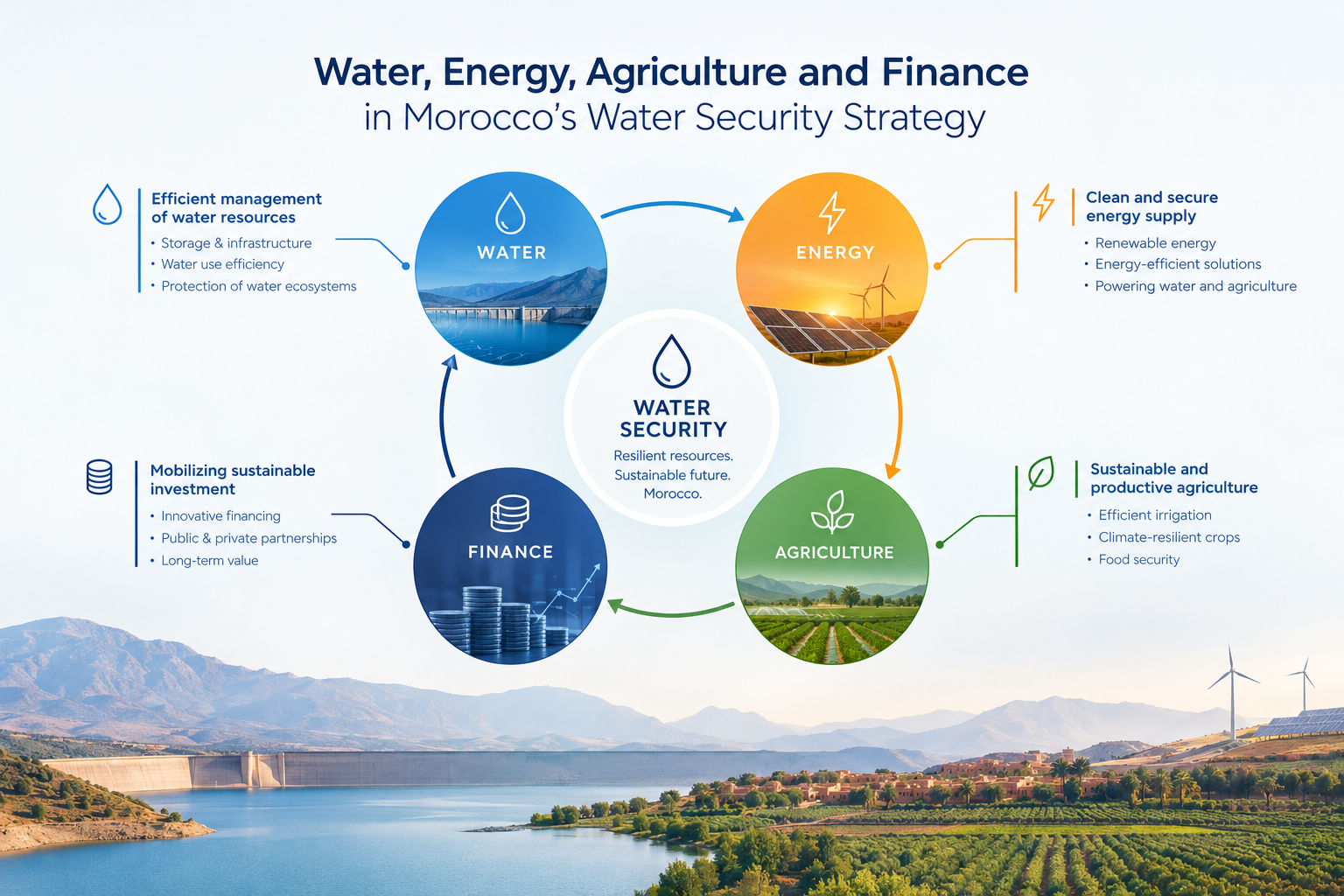
Morocco's strategy rests on a 30-year National Water Plan (2020–2050) and a National Program for Potable Water Supply and Irrigation (2020–2027). In 2023 the World Bank approved a US$350 million programme to support it. The programme covers governance, financial sustainability and non-conventional water resources.
The ambition
Desalination sits at the centre of the response. Morocco operates 17 desalination plants with a combined capacity of 345 million cubic metres a year. Its water minister told Reuters the country plans 1.7 billion cubic metres of desalinated water annually by 2030, supplying about 60% of drinking water, with new plants powered by renewable energy. That is roughly a fivefold increase in capacity in a few years.
What foresight adds
A plan like this is a strong commitment. Foresight does not question the commitment. It asks what must be true for the plan to work, and what happens if those conditions change. Questions a foresight exercise would raise include:
- Energy. How resilient is the plan if energy costs or renewable build-out differ from assumptions?
- Demand. What if agricultural and industrial demand grows faster than urban demand?
- Finance. How sustainable is the financing model if public budgets tighten?
- Equity. How do inland and rural communities, far from the coast, get secure supply?
- Environment. What are the long-term impacts of concentrated desalination on coastal ecosystems?
This list is illustrative analysis, not a forecast or an assessment of any specific project.
Foresight would turn these questions into scenarios and test the current strategy against each one. The plan then holds up under stress, and weak points are found before they become crises.
A five-step method for decision-makers
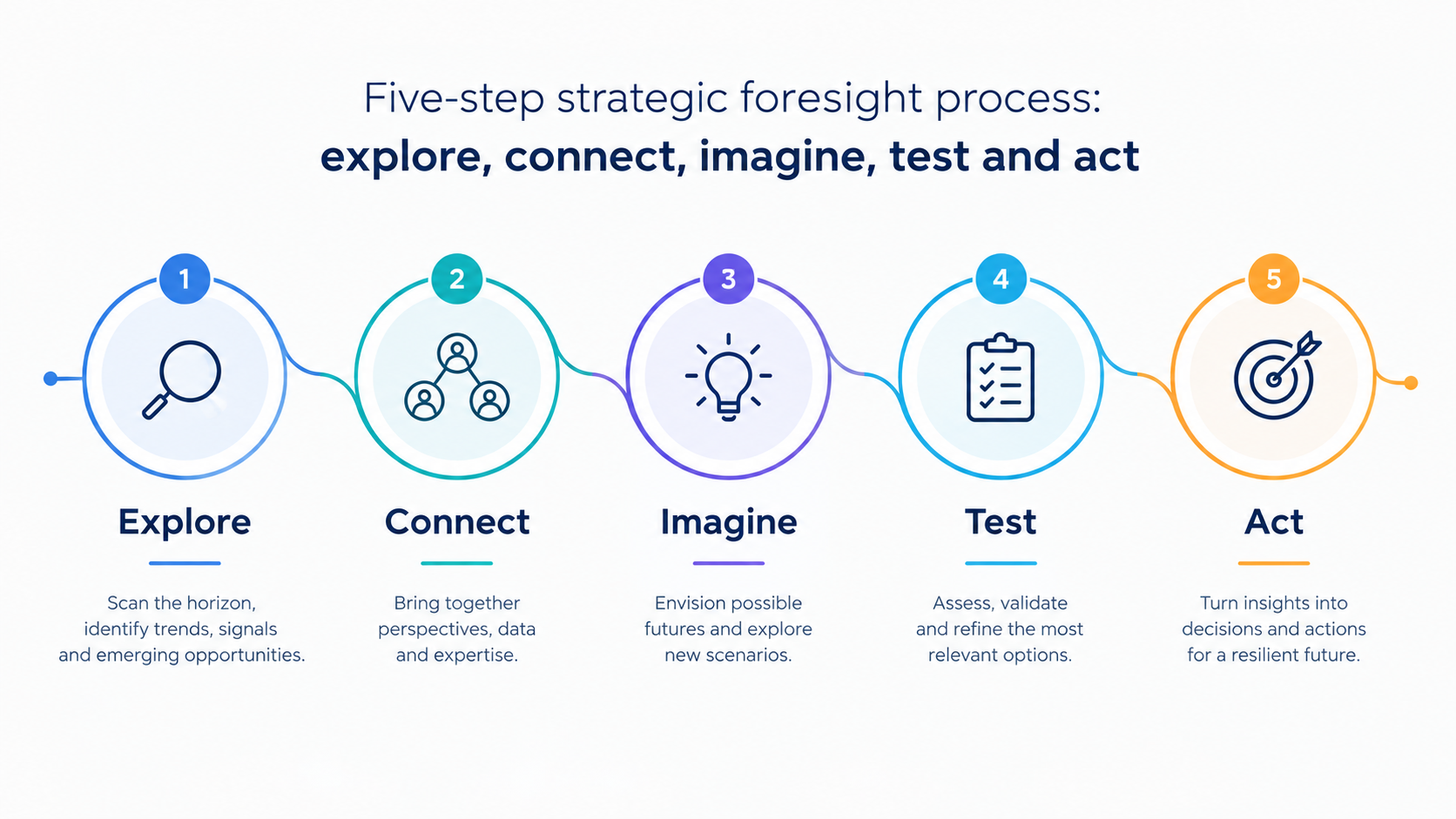
The OECD's Strategic Foresight Toolkit offers a practical template. It begins with exploring disruptions, imagining interactions, and creating scenarios, and then stress-tests strategies and develops actionable plans. Here is how each step works, using water as the example:
- Explore disruptions. List what could shift the landscape: prolonged drought, energy shocks, new water technologies. Challenge your own assumptions first.
- Imagine interactions. Ask what happens when disruptions coincide, such as drought plus high energy prices plus constrained public finance.
- Create scenarios. Build three or four distinct, decision-relevant futures. Each should be plausible and different enough to require a different response.
- Stress-test strategies. Run the current plan through each scenario. Mark where it holds, bends or breaks.
- Develop actionable plans. Choose robust moves that work across scenarios, and define early-warning signals that tell you which future is emerging.
Building foresight capacity inside institutions
Method alone is not enough. Experts at a January 2026 European Economic and Social Committee hearing stressed that foresight must be tied to real decision moments, budgets and risk management. Otherwise it loses relevance because it is detached from institutional power.
The OECD supports this through a year-long applied Policy Foresight Academy that embeds anticipatory governance across strategy, finance and regulation. The same principle drives the Morocco Future Foundation's Foresight Academy: executive learning and applied programmes that turn foresight into institutional practice.
Common mistakes to avoid
- Treating foresight as a one-off report. It is a recurring routine, not a document.
- Confusing scenarios with predictions. Scenarios are tools for testing decisions.
- Staying in expert circles. Diverse voices surface blind spots that a single discipline misses.
- Skipping the action step. A scenario that changes no decision has no value.
Key takeaways
- Strategic foresight prepares institutions for several futures. It does not predict one.
- Morocco's challenges interact, so isolated planning leaves blind spots.
- Water policy shows both the value of long-term commitment and the need to stress-test it.
- A five-step method (explore, connect, imagine, test, act) makes foresight practical.
- Foresight only works when it is tied to real decisions and budgets.
Frequently asked questions
What is strategic foresight?
Strategic foresight is a structured way of exploring multiple plausible futures to test strategies and improve long-term decisions. It focuses on preparedness. It does not aim to forecast a single outcome.
What is the difference between foresight and forecasting?
Forecasting projects the most probable future from past trends. Foresight explores several possible futures, including unlikely ones, to reveal risks and opportunities that a single projection would hide.
What are the steps of strategic foresight?
A widely used approach follows five steps: explore disruptions, imagine how they interact, create scenarios, stress-test strategies against them, and develop actionable plans.
Why is foresight important for governments?
Governments make long-lived commitments in infrastructure, education and energy under high uncertainty. Foresight helps them find weaknesses in those commitments before events expose them.
How is Morocco preparing for water scarcity?
Morocco is pursuing a 30-year National Water Plan and a large desalination programme, with a target of 1.7 billion cubic metres of desalinated water a year by 2030.
Conclusion
Uncertainty is permanent, and Morocco's institutions still have to make long-term commitments. Strategic foresight makes those commitments stronger by stress-testing them against several futures. Water shows both sides: bold long-term investment, and the open questions that foresight is designed to ask.
Next steps
Explore the Foundation's six priority fields, join the conversation through Future Dialogues and the Foresight Academy, or contribute your perspective.
Sources
- OECD, Strategic Foresight Toolkit for Resilient Public Policy
- World Bank, press release on Morocco's water security programme (July 2023)
- World Bank via ReliefWeb, water security and resilience programme
- European Economic and Social Committee, hearing summary on strategic foresight (27 January 2026)
- Smart Water Magazine, relaying Reuters on Morocco's desalination targets